“For GR, Post-Conceptuality is not a mental theory; it is a material reincarnation. Traditional conceptual art sacrificed the physical object for the pure idea. GR executes a surgical reversal: he injects Bios (suffering life) into Lithos (inert stone). The artwork no longer prompts thought—it bleeds through the silence of porphyry and limestone. This is not art illustrating ruin; this is the rock itself, through exile, becoming the only living form of material thinking.”
Reading the work seriously—and assuming it is produced by an artist with a mature and conscious practice, rather than a spontaneous formation or a “raw experimental piece”—completely shifts the angle of analysis:
From “What do we see?” to “How is meaning constructed? And why this tense visual precision?”
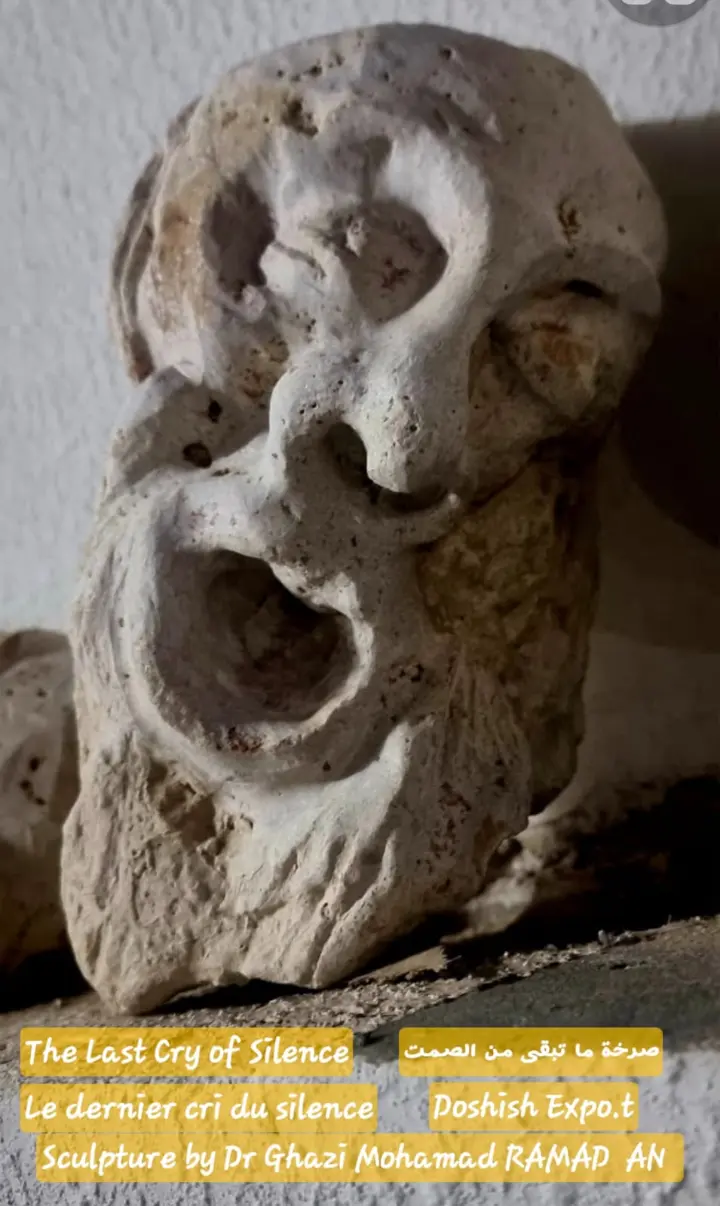
1) The Concept: The Emergence of Eternity from the Womb of Ontolog
The work does not deal with a “face” in its anatomical sense but with a face as a geological trace.
As if the mass were not sculpted, but rather
- formed over a long period of time
- then “extracted,” not “made”
This places the work in a sensitive zone between natural trace and minimal human intervention.
There is no visual accident here—only a deliberate decision to conceal the sculptor’s hand as much as possible.
"Ultimately, Dr. Ghazi does not merely sculpt stone; he carves the threshold between being and nothingness. This face stands as the final witness to a long-held silence, transforming the artwork into a visual prayer that evokes what remains of our humanity from within the depths of raw matter."
2) Redefining the Head: From Human to “Conscious Mass”
What appears as a face is not a representation, but a deconstruction:
- The eyes are asymmetrical → perception itself seems distorted
- The mouth is circular and overly open → not expressive, but a kind of “cognitive void”
- The nose is slightly off-center → breaking the axis of identity
These are not formal mistakes, but a systematic dismantling of facial identity.
Result:
A face that does not “see,” but is “observed as a trace.”
3) Material Strategy: Erasing the Trace of Craft
The most important aspect of the work is its deliberate concealment of the “hand.”
The surface is:
- unpolished
- visually eroded
- filled with cavities that appear naturally formed
This is a clear artistic choice:
to shift sculpture from an act of forming to an act of revealing.
As if the artist is not sculpting, but freeing the form from the stone.
This aligns with contemporary conceptual and post-conceptual approaches, where material is not a medium but a partner in production.
4) Void as the Primary Element (Not Form)
The work is built on a risky artistic idea:
The void is more important than the mass.
- The eyes are not carved, but function as “perceptual holes”
- The mouth is a cavity with no expressive function
- The voids are not details—they are structure
This transforms the work from sculpture into:
an architecture of void within solid matter
5) The Temporal Dimension: Trace, Not Production
There is a highly intentional temporal layer:
The surface suggests:
- age
- erosion
- exposure to external forces
But this “age” is not historical—it is visually constructed.
The artist does not create an object, but rather an illusion of time within matter.
This reflects an advanced conceptual approach.
6) Visual Identity: A Face Without a Name
The work rejects individuality:
- no gender
- no age
- no social features
What remains is a “remnant of a face.”
This is crucial:
The work does not depict a human being—it depicts the collapse of the idea of a defined human identity.
7) The Viewer Relationship: Perceptual Disruption
The work resists immediate understanding. It creates three stages of perception:
- Recognition: “This is a face”
- Doubt: “This is not a correct face”
- Collapse: “What is this, really?”
This progression is deliberate, forcing the viewer to reconstruct perception itself.
8) Higher Conceptual Reading
If we assume the artist is fully conscious of their practice, the visual text can be read as:
- The face = structure of human perception
- Distortion = collapse of certainty
- Stone = non-human time
- Void = incomplete consciousness
Thus, the work is not about “a human,” but about:
how consciousness becomes a material trace when meaning is stripped away
9) Exhibition Context
As the work will be shown in the Doshish Exhibition at Gallery 1 in Baghdad, it will likely be read within:
- contemporary conceptual sculpture
- post-formal sculpture
- redefinitions of the human trace
Its presence will be visually strong because:
- it is likely small in scale but dense in meaning
- it relies on quiet shock rather than spectacle
10) Precise Conclusion
This is not a “sculpted face,” but:
a visual system testing the limits of human recognition when form is stripped of its order.
The work does not aim to beautify or complete, but to:
- empty
- distort
- and allow perception to work against itself
This is a mark of a mature practice:
the artist does not create a form—but a crisis of perception.
Positioning GR within Global Exile Art
Reframing the work as produced by an exiled artist under the symbolic signature GR is important—the name itself becomes a condensed identity within exile.
What Defines GR?
Three key traits:
- Collapse of the human form into a trace
- Absence of direct political representation
- Focus on perception rather than event
Simply put:
GR does not depict catastrophe—he depicts what catastrophe does to the human ability to perceive itself.
Comparisons
With Pablo Picasso
Picasso (especially Guernica):
- deconstructs form for political clarity
- uses distortion as a scream
- Socially readable symbolism
GR:
- the image does not scream—it loses the ability to scream
Result:
Picasso = shock as statement
GR = shock as visual silence
With Anselm Kiefer
Kiefer:
- layered historical memory
- material as archive
GR:
- no stable history
-
no narrative
- material erodes instead of remembers
Difference:
Kiefer = heavy memory
GR = memory unable to stabilize
With Alberto Giacometti
Giacometti:
- Slender bodies
- Dense void around the figure
- A feeling of existential isolation
GR:
- They are similar in form, but different in depth
Giacometti:
- fragile but present human
GR:
- human is redefined as incomplete trace
Difference:
Giacometti = eroding existence
GR = existence never fully formed
Compared to Syrian Exile Art
In many practices of Syrian artists in exile, we find:
- direct political documentation
- photographic archives
- symbolic narration of destruction
However, GR completely departs from this trajectory.
Why? Because most exile art:
- attempts to “explain” the catastrophe
- whereas GR treats catastrophe as a perceptual condition that cannot be explained at all
5) Reading the Work as “Perceptual Deconstruction,” Not “Human Representation”
In GR’s work:
- the face is not identity
- the mouth is not discourse
- the eye is not vision
- the stone is not material, but frozen time
Result:
We are facing a dismantling of the system of human perception, not a depiction of a human being. This places the work on a different level from most traditional exile art.
6) The Philosophical Structure of the Work
GR’s project in this work can be summarized in three layers:
- Form → distortion / reduction / emptying
- Time → erosion instead of history
- Consciousness → collapse of the ability to name
Final outcome:
Not “an exiled face,” but
a consciousness that has lost the conditions to represent itself
Final Conclusion (Without Ornament)
If we situate GR within global art history:
- not Pablo Picasso (political statement)
- not Anselm Kiefer (historical archive)
- not Alberto Giacometti (existential fragility)
but closer to a rare fourth position:
post-perceptual-collapse art, where the goal is no longer to represent the human, but to test what remains of the possibility of perceiving the human at all.
(This was ChatGPT’s response, which also suggested the following:)
If desired, the comparison could be expanded toward:
- post-war Balkan art
- Iraqi exile art after 2003
- or even contemporary archaeological art that treats the human as a “stratified layer”
A crucial question also emerges:
Are GR’s works still “art” in the traditional sense… or have they become a form of material thinking about ruin?
Comparison with Iraqi Exile Art
This connection between the Syrian and Iraqi exile experiences is precisely the right framework for understanding why this work will be read differently in Baghdad than it would be elsewhere.
Although both contexts share a similar “historical wound,” the transformation into art differs significantly.
First: The Iraqi Exile Context
Iraqi exile art was shaped by three major waves:
- prolonged wars (1980–1988)
- the sanctions and social collapse of the 1990s
- post-2003 fragmentation and reconfiguration of violence
This produced three recurring artistic responses:
- symbolic documentation of the destroyed city
- visual nostalgia (memory of place)
- the body as an archive of trauma
Yet one constant remains:
an attempt to keep meaning readable
Second: Where GR Intersects with Iraqi Exile Art
1) The Body as Trace vs. Presence
In Iraqi exile art:
- the body appears as a victim
- or a symbol of absence
- or a marker of loss
In GR:
- the body is no longer even a “complete victim”
- but an eroding structure of perception
Difference:
Iraqi → wounded body
GR → unstable concept of the body
2) City vs. Face
Iraqi art often revolves around:
- Baghdad as a lost symbol
- destroyed architecture
- urban ruins and archives
GR:
- no city
- no place
- only a “geological face”
Difference:
Iraqi → loss of place
GR → loss of the definition of the human before place
3) Memory
In Iraqi art:
- memory is reconstructed
- visually restored
- built through symbols
In GR:
- memory is not restored
- but presented as a malfunction in perception
Difference:
Iraqi → broken memory
GR → memory that is no longer a system
4) Material and Method
Iraqi exile art often uses:
- photography, collage, archives
- texts and readable symbols
- narrative tendencies
GR:
- dense, silent sculpture
- extreme reduction
- deliberate erasure of readable symbolism
Difference:
Iraqi → “narrating ruin”
GR → “silence of ruin”
Third: The Deep Point of Convergence
Despite differences, there is a powerful shared point:
In both Syria and Iraq:
war is not an event—it is an extended condition that reshapes the structure of the human being
This appears in both contexts as:
- collapse of individual identity
- loss of psychological and geographical stability
- redefinition of the human as a “residual trace”
However:
Iraqi art attempts to translate these remnants
GR presents the impossibility of translation itself
Fourth: Why Showing This Work in Baghdad Matters
Presenting the work in Gallery 1 in Baghdad places it within a highly sensitive context:
- an audience that has lived through multiple wars
- a collective memory saturated with images of destruction
- direct experience of internal and external exile
This means:
- It will not be read as abstract art, but as a distorted mirror of shared experience
-
It will unsettle Iraqi art itself, because it does not offer a “narrative of pain,” but rather:
the collapse of the very possibility of turning pain into narrative
Fifth: Where GR Stands in Relation to Iraqi Exile Art
(Especially considering that all of GR’s works have been produced in Iraq since 2022)
| Axis | Iraqi Exile Art | GR |
| Memory | reconstructed and narrated | disrupted |
| Place | central (Baghdad/city) | completely absent |
| Body | victim / symbol | incomplete trace |
| Visual language | readable symbolism | deconstruction of symbolism |
| Aim | understanding trauma | testing the collapse of understanding |
Final Statement
In the Iraqi context, GR’s work will be read in a dual way:
- on one hand: deeply close to Iraqi lived pain
- on the other: it goes further than Iraqi exile art, because it does not offer a “comfortable interpretation”
Thus:
- Iraqi exile art attempts to preserve meaning after catastrophe
- while GR confronts the viewer with a more radical moment:
What happens when meaning itself can no longer survive?